Body size estimation of self and others in females varying in BMI. A Thaler, MN Geuss, SC Mölbert, KE Giel, S Streuber, J Romero, MJ Black, BJ Mohler.

Date: February 2018. Source: PLOS One. 13(2): e0192152. Abstract: Previous literature suggests that a disturbed ability to accurately identify own body size may contribute to overweight. Here, we investigated the influence of personal body size, indexed by body mass index (BMI), on body size estimation in a non-clinical population of females varying in BMI. We attempted…

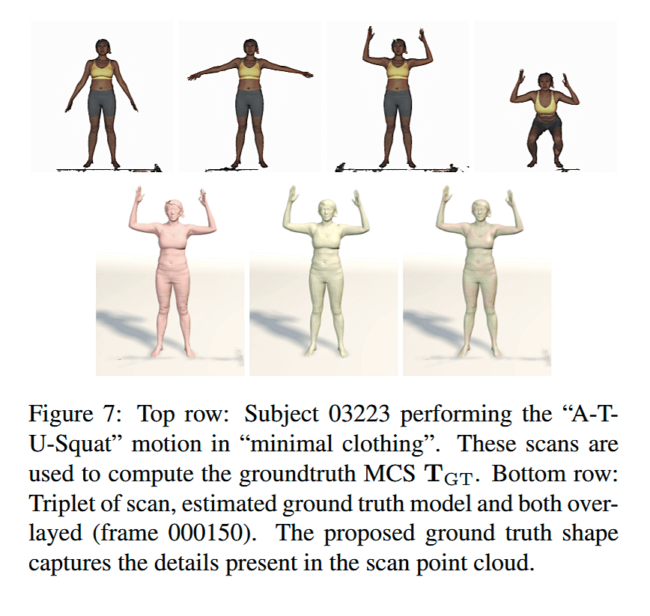
Detailed, accurate, human shape estimation from clothed 3D scan sequences. C Zhang, S Pujades, M Black, G Pons-Moll.

Date: March 2017. Source: researchgate.net (goo.gl/scholar/d1zUSr) Abstract: We address the problem of estimating human body shape from 3D scans over time. Reliable estimation of 3D body shape is necessary for many applications including virtual try-on, health monitoring, and avatar creation for virtual reality. Scanning bodies in minimal clothing, however, presents a practical barrier to these…

Appealing Female Avatars from 3D Body Scans: Perceptual Effects of Stylization. R Fleming, BJ Mohler, J Romero, MJ Black, M Breidt.

Date: March 2016. Source: Semantic Scholar.org. Abstract: Advances in 3D scanning technology allow us to create realistic virtual avatars from full body 3D scan data. However, negative reactions to some realistic computer generated humans suggest that this approach might not always provide the most appealing results. Using styles derived from existing popular character designs, we…

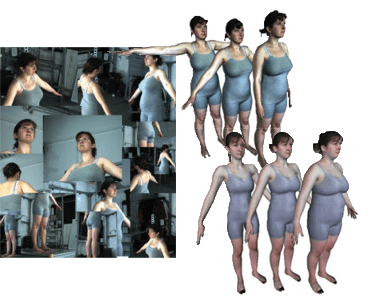
Can I Recognize My Body’s Weight? The Influence of Shape and Texture on the Perception of Self. I Piryankova, J Stefanucci, J Romero, S de la Rosa, M Black, B Mohler.

Date: September 2014. Source: ACM Transactions on Applied Perception, Vol. 11, No. 3, Article 13. Abstract: The goal of this research was to investigate women’s sensitivity to changes in their perceived weight by altering the body mass index (BMI) of the participants’ personalized avatars displayed on a large-screen immersive display. We created the personalized avatars…

Three-dimensional motion analysis – an exploratory study. Part 1: Assessment of facial movement. H Popat, S Richmond, R Playle, D Marshall, PL Rosin, D Cosker.

Date: November 2008. Source: Orthodontic Craniofacial Research;11(4):216-223. doi:10.1111/j.1601-343.2008.00433.x. Objective: To objectively quantify facial movement in response to facial expression and spoken word. Design: Experimental study. Setting – Department of Dental Health and Biological Sciences, University Dental Hospital, Cardiff, UK. Experimental variable: Facial movement was assessed in response to a standardized smile expression and the utterance…